
- Admin
- August 29, 2020
- Restaurant Menu Strategy & Pricing
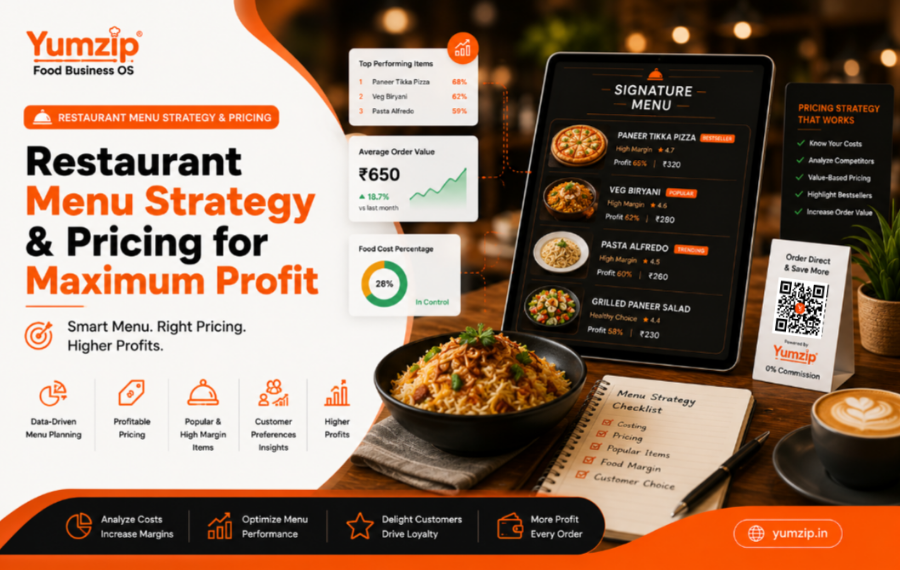
Restaurant Menu Strategy & Pricing for Maximum Profit
Restaurant Menu Strategy & Pricing: How to Design a Profitable Menu That Increases Sales
In the restaurant business, your menu is not just a list of dishes — it is your most powerful sales tool.
A well-designed menu strategy can:
- Increase average order value
- Improve profit margins
- Reduce food cost waste
- Influence customer decisions
- Boost repeat orders
If your pricing and menu layout are wrong, even high sales won’t translate into profit.
Let’s break down how to build a smart restaurant menu strategy that actually increases profitability.
1. Understand Your Food Cost & Profit Margins
Before setting prices, calculate:
- Cost per dish (ingredients + packaging + preparation)
- Ideal food cost percentage (usually 28%–35%)
- Target profit margin
Example:
If a dish costs ₹120 to make and your target food cost is 30%,
Selling price should be around ₹400.
Formula:
Selling Price = Food Cost ÷ Target Food Cost %
Without this clarity, pricing becomes guesswork.
2. Use Menu Engineering (Stars, Plowhorses, Puzzles, Dogs)
Professional restaurants use menu engineering to categorize items:
⭐ Stars – High profit + High popularity
🐎 Plowhorses – Low profit + High popularity
🧩 Puzzles – High profit + Low popularity
🐶 Dogs – Low profit + Low popularity
Strategy:
- Highlight Stars
- Reprice or redesign Plowhorses
- Promote Puzzles
- Remove Dogs
This alone can increase profit by 10–20%.
3. Smart Psychological Pricing
Small pricing tweaks change buying behavior:
- ₹299 instead of ₹300
- Remove currency symbol (299 instead of ₹299)
- Use price anchoring (Premium item at top to make others look affordable)
- Bundle combos to increase average order value
Customers compare visually — not mathematically.
Limit Menu Overload
More items ≠ More sales.
Too many options:
- Confuse customers
- Slow down kitchen
- Increase wastage
- Reduce operational efficiency
Ideal number:
- 5–7 items per category
- Focus on best sellers
Simple menu = faster decisions = higher conversion.
5. Highlight High-Margin Items
Use:
- Boxes
- Icons
- Chef’s Special tags
- Strategic placement (top right section)
Eye-tracking studies show customers look at:
- Center
2. Top right
3. Top left
Design accordingly.
6. Optimize for Online Ordering
If your restaurant has:
- Own website
- WhatsApp ordering
- Direct ordering system
Then structure your digital menu differently:
- Clear categories
- Bestsellers section
- Add-ons & upsells
- Combo suggestions
Online menus must be optimized for mobile first.
7. Use Data to Adjust Pricing
Track:
- Best selling items
- Low-performing items
- Order frequency
- Average order value
Data-based pricing decisions always beat emotional decisions.
8. Reduce Commission Loss Impact
If you are paying 25–30% commission to aggregators:
You must:
- Increase menu price on aggregator
- Keep direct ordering price slightly lower
- Promote direct orders
This protects your margin without losing customers.
Final Thoughts
A profitable restaurant is not built on sales volume alone — it is built on smart menu strategy and pricing control.
Your menu should:
- Increase profit
- Influence decisions
- Improve operational efficiency
- Encourage repeat orders
If designed correctly, your menu becomes your silent salesman.